
Home
> Dissertation project Dissertation Project
ABSTRACTThe purpose of the study was to assess animated demonstrations to consider the worked example and variability effects (Paas and van Merriënboer, 1994; Sweller & Chandler, 1991), and determine if demonstration users would exhibit a delayed performance decrement, described as Palmiter’s animation deficit (Lipps, Trafton & Gray, 1998; Palmiter & Elkerton, 1991). The study used Techsmith Morae to measure and record performance time, accuracy and relative condition efficiency (RCE) (Paas and van Merriënboer, 1994; Techsmith, 2004). It addition, it developed a new metric called performance efficiency (PE), which is an objective measure that is similar to relative condition efficiency (Paas and van Merriënboer, 1994). Results revealed the animated demonstration groups (demo+practice and demo2+practice groups) assembled the week one problem scenario in significantly less time than the practice group. This is positive evidence for the worked example effect (Sweller & Chandler, 1991) but now given animated demonstrations. In addition, subjects from the demonstration groups were found to be significantly more efficient (given performance efficiency), than those from the practice group. Finally group performance did not differ a week later, providing no evidence of Palmiter’s animation deficit.
|
|||||||||||||||||||||||||

Overview |
|||
|
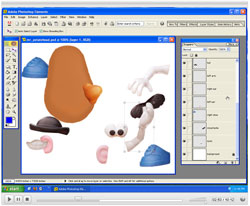
Condition 1 Demonstration (only) |
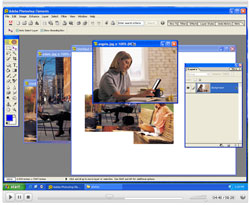
Condition 2 Demonstration + Practice |
Condition 3 Demonstration 2 + Practice |
Condition 4 Practice (only) |
 |
|
 |
 |
| no practice |
 |
|
|
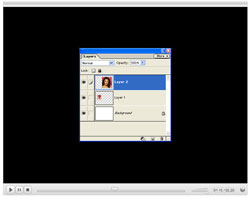
Initial practice for conditions 2,3, and 4
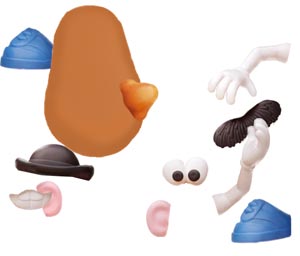
After viewing the instructional materials some groups of learners (conditions 2,3, and 4) must reassemble a disassembled "Mr. Potato head" document w/ Adobe Photoshop Elements 2.0.
| Disassembled Mr. Potato head | Reassembled Mr. Potato head |
|
|
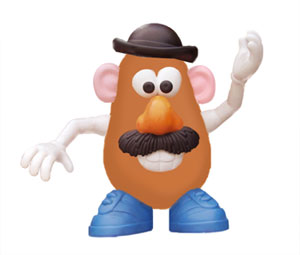 |
After taking part in an instructional condition, all learners concluded the activities by completing a post-treatment survey.
Retention phase (Week Two) - Delayed Practice with a different problem scenario
One week later, all learners assembled a different problem scenario (the picnic problem). This problem requires learners to use their newly learned skills in a new context. This new scenario is similar in many respects to the Mr. Potato head document, but is somewhat more complicated. In this new problem scenario, learners must reassemble a disassembled scene with Adobe Photoshop Elements 2.0
| The Picnic Problem | A Reassembled Picnic Scene |
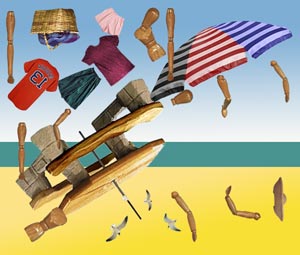 |
 |
Survey 2
In addition to gathering more direct, objective measurements of cognitive load, Survey 2 is intended to gather introspective data to grasp a more subjective measure of cognitive load. Paas (1992) pioneer this type of cognitive load measurement.
Survey 2 also asks the learner if they have used Photoshop over the past week. This is done to see if long term retention has been altered by interaction with the software over the intervening week.
RESULTS
A MANOVA of performance time and accuracy was used to compare group performance. During week one, it was hypothesized that the demonstration learners would out-perform those in the practice condition. During an analysis of the assumptions of the MANOVA, several multivariate outliers were detect and removed. In addition transformations were employed. Once the MANOVA was conducted it was found that there was a significant difference between groups, Wilks’ Λ=0.68, F (2, 68) = 6.83, p <0.0001, η2=0.32. Post hoc comparisons with Scheffé’s test (p<0.025) revealed that the demonstration groups (demo+practice and demo2+practice groups) assembled the problem, in significantly less time than the practice group, which is positive evidence for the worked example effect (Sweller & Chandler, 1991) given animated demonstration. During week two, a similar MANOVA revealed no differences between groups.
While this study considered the learner performance from a human computer interaction (HCI) perspective, it also considered learners from a cognitive load perspective, by measuring relative condition efficiency (Paas and van Merriënboer, 1993). In addition, it developed a new measure called performance efficiency. During week one, the demonstration conditions were found to be significantly different F (2, 68) = 3.69, p=0.03, given relative condition efficiency. This is positive evidence of the variability effect. However in post hoc comparisons these instructional conditions were not found to differ. Performance efficiency was found to be significantly different, during week one, F (2, 68) = 12.95, p<0.0001, and post hoc comparisons with Scheffé’s test (p<0.05) revealed the demonstration learners were significantly more efficient, than the practice learners. During week two, groups did not differ, suggesting once learners had practiced procedures they would all perform equally well.
DISCUSSION
Those who studied
animated demonstrations assembled the week one problem, in significantly less
time than those who learned through problem solving. This result is consistent
with the worked-example effect (Sweller & Chandler, 1991; Tuovinen and Sweller,
1999). In addition, Performance efficiency was found to be significantly
different, since week one demonstration learners were significantly more
efficient, than practice learners. Since week two performances did not differ,
the findings of the current study do not support Palmiter’s animation
deficit given animated demonstrations, further confirmation of the results by
Lipps, Trafton, and Gray (1998).
In addition to finding evidence of the worked example effect, this study
demonstrated the utility of a new metric called “performance efficiency,” and
used this measure to compare several instructional conditions, to objectively
analyzed the relative efficiency of learner performance.
Well-known companies, like Bank of America, Amazon.com and Microsoft, are all using animated demonstrations (demos) as a way to teach clients how to use their products and services. The results of this study show this practice improves learner performance and this method of instruction is an efficient means of teaching procedural skills. Therefore, it is the recommendation of this study that developers continue to use this effective and now evidence-based strategy, to provide learners with an efficient instructional strategy for accomplishing procedure-based learning.
REFERENCES
Adobe Systems. (2002). Adobe Photoshop Elements 2.0 [Computer program] Mountain View, CA
Cooper, G., & Sweller, J. (1987). Effects of schema acquisition and rule automation on mathematical problem-solving transfer. Journal of Educational Psychology. 79(4), 347-362.
Clark, R.C., Nguyen, F., and Sweller, J. (2006a). Efficiency in learning: evidence-based guidelines to manage cognitive load. San Francisco: Pfeiffer.
Lewis, D. (2005). Demobank: a method of presenting just-in-time online learning. In the Proceedings of the Association for Educational Communications and Technology (AECT) Annual International Convention (vol 2, p. 371-375) October 2005, Orlando, FL.
Lipps, A. Trafton, J. and Gray, W. (1998). Animation as documentation: A Replication with Reinterpretation. In the Proceedings for the 45th annual conference of the Society for Technical Communication Arlington, VA. retrieved June 12, 2003 from http://www.stc.org/proceedings/ConfProceed/1998/PDFs/00006.PDF
Paas, F., Tuovinen, J. E., Tabbers, H. K., & Van Gerven, P. W. M. (2003). Cognitive load measurement as a means to advance cognitive load theory. Educational Psychologist, 38 (1), 63–71
Paas, F. G. W. C., and van Merrienboer, J. J. G. (1993). The efficiency of instructional conditions: An approach to combine mental-effort and performance measures. Human Factors, 35(4), 737-743.
Palmiter, S. & Elkerton, J. (1991). An evaluation of animated demonstrations of learning computer-based tasks. In the Proceedings of the SIGCHI conference on Human factors in computing systems: Reaching through technology. New Orleans, Louisiana, United States. p.257 - 263
Sweller, J., & Cooper, G. A. (1985). The use of worked examples as a substitute for problem solving in learning algebra. Cognition and Instruction, 2(1), 59-89.
Techsmith (2004).TechSmith
Morae1.0.1[Computer program] Okemos MI